

Order fulfillment for decorators is the end-to-end process of receiving a customer order, verifying payment, sourcing blanks, approving artwork, running production, passing quality control, and shipping the finished custom product. This process is also called decorator order processing in the industry, and it covers every handoff between your sales team, prepress, production floor, and shipping dock. Platforms like DecoNetwork, OrderMyGear, and Printify have built entire systems around this workflow because getting even one step wrong means reruns, refunds, and frustrated customers. If you want to run a tight shop, understanding each stage is the first move.
What is order fulfillment for decorators, step by step?
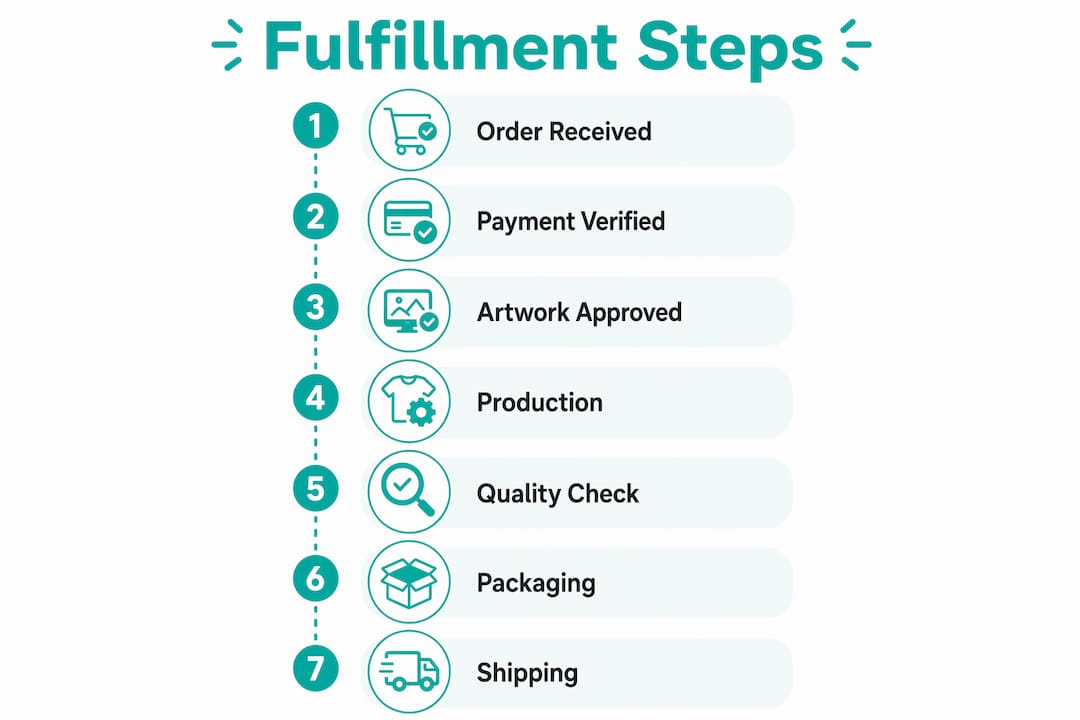
Order fulfillment for decorators follows a defined sequence of status gates, and each gate acts as a checkpoint that keeps every department synchronized before the next stage begins. Think of it less like a checklist and more like a state machine. No stage advances until the previous one is confirmed. That structure is what separates high-volume shops from ones that constantly chase errors.
Here are the core stages in sequence:
-
Order receipt and payment verification. The order enters your system and payment is confirmed before anything else moves. Verifying payment before production eliminates wasted runs on orders that never clear. This single gate saves real money.
-
Sourcing blanks and inventory. Once payment clears, you pull or order the garments, substrates, or products needed. Stockouts at this stage are one of the top causes of missed ship dates, so real-time inventory visibility matters here.
-
Artwork proofing and customer approval. This is the step most unique to decorators. You send a digital proof to the customer and collect a signed-off approval before the job enters the production queue. Artwork approvals prevent late-stage changes that force reruns and disrupt your entire production schedule.
-
Production scheduling. Approved jobs get slotted into your production calendar based on equipment availability, order priority, and due dates. Shops without a formal scheduling step often end up with bottlenecks at their busiest machines.
-
Decoration and printing. The actual work: screen printing, embroidery, DTF transfers, sublimation, or any other method. Quality starts here, not at the inspection stage.
-
Quality control inspection. Every finished piece gets checked against the approved proof for color accuracy, placement, and consistency. Catching errors here is far cheaper than catching them after the customer opens the box.
-
Packaging and shipping. Orders are packed, labeled, and handed off to your carrier. Tracking information is generated and sent to the customer.
Pro Tip: Set your system so no job can move from artwork approval to production without a logged customer sign-off. One skipped approval can cost more in reprints than a week of saved time.
How do modern platforms change order management for decorators?

The right platform turns a fragmented, email-heavy process into a single source of truth for your entire shop. OrderMyGear centralizes quote-to-invoice workflows including supplier purchase orders, artwork approvals, and real-time customer updates, which cuts the back-and-forth that kills productivity in busy shops.
Here is what well-built order management platforms deliver for decorators:
- Centralized job data. Quotes, purchase orders, artwork files, approval status, and shipping details all live in one place. No more hunting through email threads to find out if a proof was approved.
- Automated proof requests. Platforms like DecoNetwork send proofs directly to customers and track responses, so your prepress team is not manually following up on every job.
- Real-time production tracking. Every department sees the current status of every order. Sales knows when production is complete. Shipping knows when QC has signed off.
- Automated customer notifications. Customers receive updates at key milestones without your team lifting a finger. This reduces inbound “where is my order?” calls significantly.
- Routing by capability and capacity. In networked fulfillment models, Brikl automatically routes orders to decorators based on their equipment, location, and current workload. This is especially useful for distributors managing multiple decorator partners.
“Routing and tracking consistency are vital when managing multi-provider fulfillment networks. Decorators rely on complete job data, including specs, placement, quantities, and address rules, to efficiently complete, QC, and ship orders without manual clarifications.” — Brikl
The practical result is faster turnaround and fewer errors. When your team is not manually updating spreadsheets or chasing approvals by email, they spend that time on production. For high-volume shops, that shift alone can add meaningful capacity without adding headcount.
What challenges do decorators face in fulfillment, and how do you fix them?
The most expensive problems in decorator fulfillment are almost always preventable. They cluster around three failure points: artwork approvals, inventory gaps, and communication breakdowns between departments.
Artwork proof approvals prevent late changes that force reruns and disrupt production scheduling across machines and inventory slots. Yet many shops still treat the approval step as optional or informal. A customer who verbally says “looks good” over the phone is not the same as a customer who has clicked approve on a digital proof. That distinction matters when a dispute arises.
Common fulfillment challenges and their fixes:
- Missing artwork approvals. Require a logged digital sign-off before any job enters the production queue. No exceptions.
- Inventory stockouts. Use real-time inventory tracking and set reorder points for your most common blanks. Catching a stockout before production starts beats discovering it mid-run.
- Miscommunication between departments. Status gates in platforms like DecoNetwork give every team a shared view of where each order stands. This replaces the “did you check with production?” phone calls.
- Shipping errors. Verify addresses and carrier selections at the packaging stage, not after the label prints. A wrong zip code caught early costs nothing. A returned shipment costs real money.
- Capacity overcommitment. Scheduling more jobs than your equipment can handle in a given window is a common growth-stage mistake. Use production calendars and set realistic lead times before confirming orders.
Pro Tip: Treat your fulfillment workflow as a chain of verified steps. Thinking of fulfillment as verified steps reduces waste and operational costs more reliably than any single tool or shortcut.
The shops that run the cleanest operations are not necessarily the ones with the most equipment. They are the ones with the clearest processes and the discipline to follow them on every single order.
Print-on-demand vs. traditional decorator workflows: how do they compare?
The fulfillment model you use shapes everything from your cash flow to your customer communication. Print-on-demand (POD) and traditional decorator workflows both deliver custom products, but they operate very differently.
Printify’s POD fulfillment automates order reception, payment verification, provider assignment, production, QC, packaging, and shipping with tracking integration. The decorator in a POD model never touches inventory. Orders flow in, get routed to a production provider, and ship directly to the end customer. The tradeoff is less control over quality and packaging.
| Factor | Print-on-demand | Traditional decorator workflow |
|---|---|---|
| Inventory | None held; no upfront cost | Blanks sourced and stored before production |
| Production trigger | Automatic on order receipt | Manual scheduling after payment and approval |
| Quality control | Provider-managed; limited visibility | In-house inspection at each stage |
| Turnaround time | Fast for standard products | Variable; depends on scheduling and capacity |
| Customization depth | Limited to provider capabilities | Full control over methods and materials |
| Customer communication | Automated tracking updates | Mix of manual and platform-driven updates |
| Best for | High-SKU, low-volume, direct-to-consumer | Custom bulk orders, complex decoration, B2B |
Traditional workflows give you more control and the ability to handle complex, multi-decoration jobs. POD works well for decorators who want to offer a wide product catalog without carrying inventory risk. Many shops run both models simultaneously, using POD for overflow or standard catalog items while keeping complex custom work in-house.
Key takeaways
Decorator order fulfillment works best when every stage is a verified checkpoint, not an assumption.
| Point | Details |
|---|---|
| Fulfillment is a state machine | Each status gate must be confirmed before the next stage begins to prevent errors. |
| Artwork approval is the critical gate | A logged digital sign-off before production prevents costly reruns and schedule disruptions. |
| Platforms centralize the process | Tools like DecoNetwork, OrderMyGear, and Brikl replace email chaos with real-time visibility. |
| POD and traditional workflows serve different needs | Choose based on order complexity, volume, and how much production control you require. |
| Payment verification protects your margin | Confirming payment before sourcing blanks or scheduling production eliminates wasted runs. |
Why artwork approval is the one step you cannot afford to skip
After working with decorators across a range of shop sizes, the single most consistent source of expensive problems is the same every time: production started before the customer actually approved the artwork. Not “said it looked fine.” Actually approved it, in writing, with a timestamp.
Shops that treat artwork approval as a formality tend to discover the problem at the worst possible moment. The shirts are printed, the customer sees them in person, and suddenly the font is “not quite right” or the placement is “a little high.” At that point, you are eating the cost of a rerun or negotiating a discount you did not budget for.
The fix is not complicated. It is a process change, not a technology purchase. Require a digital proof approval for every job, log it in your order management system, and do not let any job advance to production without it. Platforms like DecoNetwork make this automatic, but even a simple email confirmation with a clear subject line is better than nothing.
The other thing I have seen trip up growing shops is capacity management. It is tempting to say yes to every order when business is good. But overcommitting your production calendar creates a cascade of late orders, rushed QC, and shipping errors that damage your reputation faster than a slow month ever would. Build your lead times honestly and protect them.
— Chris
How Transferhippo fits into your fulfillment workflow
If your fulfillment process involves custom apparel decoration, the quality of your transfers directly affects your QC pass rate and your customer satisfaction. Transferhippo is built for decorators who need fast, consistent DTF transfers without setup fees or minimums. Orders placed before noon EST ship same day, with delivery in 1 to 2 days across the mainland US. That kind of turnaround fits cleanly into tight production schedules.
The DTF Gang Sheet Builder lets you lay out multiple designs on a single sheet, which cuts material waste and keeps your per-unit cost low. For decorators adding hard goods to their catalog, UV DTF Stickers deliver vibrant, durable results with the same no-minimum ordering model. Press 'em, pack 'em, ship 'em. Transferhippo keeps your production moving.
FAQ
What is order fulfillment for decorators?
Order fulfillment for decorators is the complete process from receiving a customer order through payment verification, artwork approval, production, quality control, and final delivery of the custom decorated product. It covers every handoff between departments and is often managed through platforms like DecoNetwork or OrderMyGear.
Why is artwork approval so important in decorator fulfillment?
Artwork approvals prevent late-stage production changes that force costly reruns and disrupt scheduling. A logged digital sign-off before production starts is the single most effective control point in the entire fulfillment workflow.
What platforms help decorators manage orders?
DecoNetwork, OrderMyGear, Printify, and Brikl each offer order management tools built for decorators. They centralize quotes, purchase orders, artwork approvals, production tracking, and customer notifications in one system.
How does print-on-demand fulfillment differ from traditional decorator workflows?
POD fulfillment is fully automated from order receipt to delivery with no inventory held, while traditional workflows involve sourcing blanks, manual scheduling, and in-house quality control. Traditional workflows offer more customization depth; POD works better for high-SKU, low-volume catalog products.
When should payment be verified in the fulfillment process?
Payment verification before production is the first confirmed gate in any decorator fulfillment workflow. Confirming payment before sourcing blanks or scheduling production eliminates wasted runs on orders that do not clear.


